WORDS BYHoihnu Hauzel
ILLUSTRATIONS BYSumedha Sah
The golden dracaena used to sit by the window, tall and radiant, catching the breeze that moved through the lace curtains in my brother and sister-in-law’s room. It had grown from a sickly little plant, the kind most would discard, into something full and strong. It had a leafy presence that seemed to listen when we spoke, to lean into the light like it trusted the world. That room, with its soft white sofas, you could sink into and stay there for hours. You could lose whole afternoons there, doing nothing. Perhaps, sipping tea, talking in low voices, or just watching the wind move the curtains as my niece played piano. Or just hear the steady tap-tap of my dad typing away on his laptop, while just next door, or, knowing that my mother sits quietly in the family parlour, sipping her sugarless milky tea.
My niece’s nimble fingers danced across the keys with the uncertainty of youth and the determination only children possess. Her feet never quite reached the pedals, but the music still came, hesitant, beautiful. We knew it was her. That was always soothing.
It was a house where the light pooled in corners, and every object had a story. Like when it was bought and how it made us so happy. That plant was part of it all, just a green silhouette in the corner, but somehow it stood for something more. Now, the same plant stands on my balcony in Gurgaon, far away from where it once belonged in Imphal, the capital of Manipur. Sometimes, when I water it, I pause and cry because, for a moment, the air smells like home: the wood polish of the piano, the scent of the monsoon on old walls, the muffled laughter from the kitchen.

The memory always ends the same way with the night of May 3rd, 2023. That was the night everything burned. The house, the piano, the soft sofas, the window with the dancing curtains. Even the street, which once pulsed with everyday life. My neighbours calling across fences, scooters rumbling past, dogs barking at the same time each evening fell silent in the wake of the flames.
And yet, in Gurgaon, the dracaena grows in a pot. It has no idea that its last home is gone.
I find myself drawn to nurseries here, where plants line up in tidy rows, unaware of their future homes. Whenever I pass the bonsai section, something stops me. It’s not just the craftsmanship or the allure of miniature trees. It’s my elder sister. She had a way with plants, especially the ones most people ignored. Broken twigs, unwanted saplings, nearly dead branches picked off roadsides, she would bring them home like wounded birds. And with the same fierce care, she turned them into bonsai.
She wasn’t fussy about the pots, for anything that’s discarded seems like a treasure. So, there were cracked pots, leaking kettles, aluminium bowls, and broken buckets. She would repurpose each, with an inborn talent for creation. The entire terrace of our house in Imphal was her retreat or a studio. It was wild and humble and alive in a way curated gardens never are. Each bonsai carried its own story. The guava sapling, carefully dug out from a crack in the earth; the peepal, uprooted from a wild bush.
So now, even in this city, when I see a small tree shaped by careful hands, I remember that terrace, the sun glinting off tin containers, my sister bent over a plant with a pair of rusted scissors, the wind teasing her curly hair.
She wasn’t fussy about the pots, for anything that’s discarded seems like a treasure. So, there were cracked pots, leaking kettles, aluminium bowls, and broken buckets. She would repurpose each, with an inborn talent for creation. The entire terrace of our house in Imphal was her retreat or a studio. It was wild and humble and alive in a way curated gardens never are. Each bonsai carried its own story. The guava sapling, carefully dug out from a crack in the earth; the peepal, uprooted from a wild bush.
So now, even in this city, when I see a small tree shaped by careful hands, I remember that terrace, the sun glinting off tin containers, my sister bent over a plant with a pair of rusted scissors, the wind teasing her curly hair.
And just like that, I am home again. For a moment, in my mind.
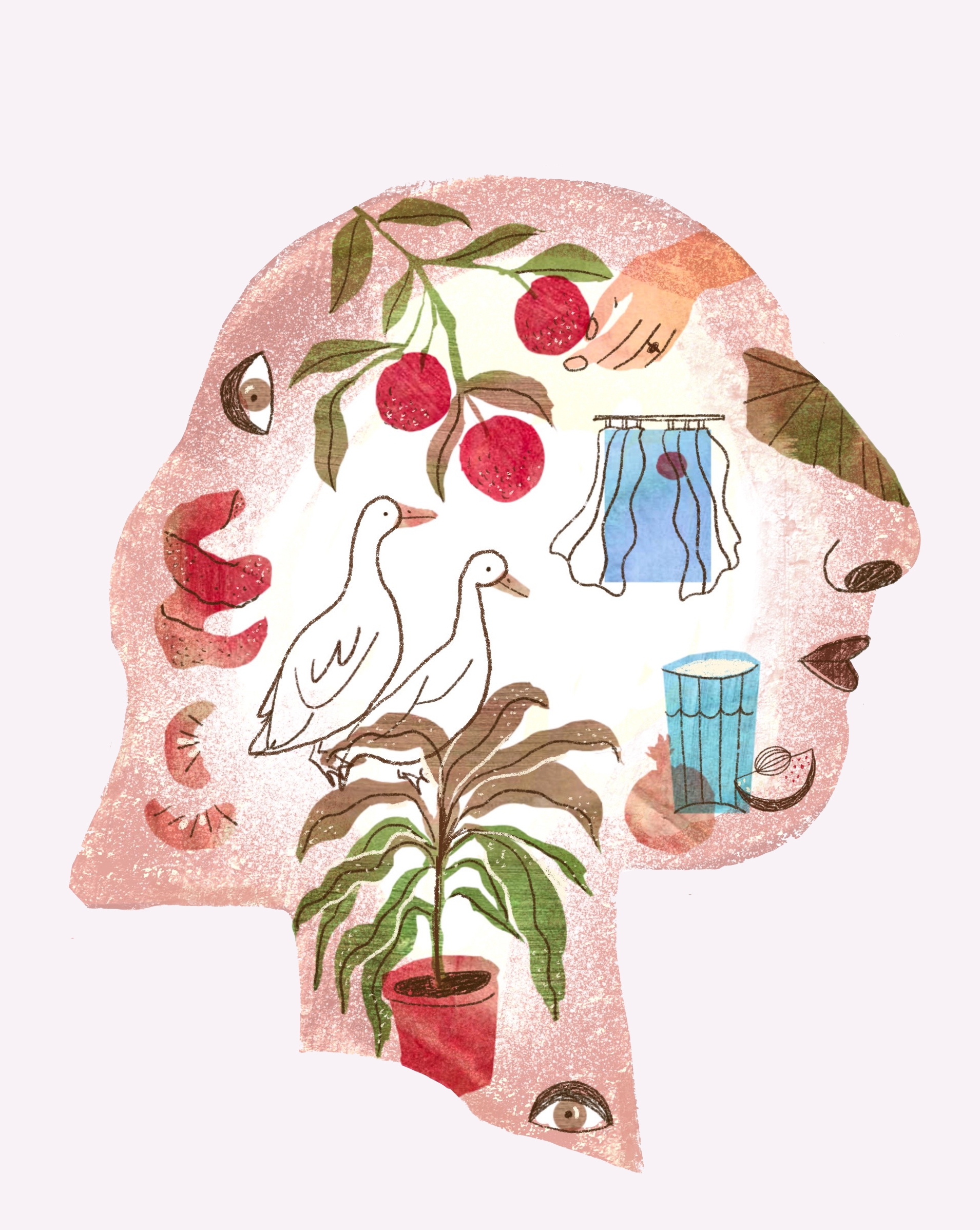
It happens too when I see oranges. Especially the fresh ones, still holding the warmth of the sun in their skin. They take me back to one long-ago Sunday in our old colony. My grandfather’s orange tree stretched over the roof of the garage, its branches heavy with fruit. I must have eaten thirty that afternoon, climbing up onto the warm tin roof, the metal hot under my feet, peeling the oranges one by one and letting the juice run down my arm.
Everyone knew where I was. They saw me, but the adults were engrossed in their gossip on the veranda, fans lazily turning above their heads. I was alone with the sky, the sun, and that tree. Underneath, the ducks were quacking. I still remember how one orange tasted sweeter than the last, how I slid back into the kitchen unnoticed, sprinkled one with salt, and ate it like it was a secret.
That tree, I am told, shrivelled in the flame that night. But it watched in silence. That three-story house of my granddad, now cloaked in soot, looks as if it exists only in a fading dream. And yet that taste, that perfect balance of sweet and sun, is still with me. It visits sometimes, unannounced.
So do the pomegranates. In the same garden of my grandfather. So many afternoons, my aunt would ask me to go and pluck. I was little, and she could order me around. Not the plump, glossy kind from supermarkets. Ours were smaller, wild, with seeds so sour they made you wince. We used to gather them, split them open, and wrap the seeds in yam leaves. That became our little salad, raw, earthy, daring. Made better with a sprinkling of salt. And then there were the gooseberries. Picked in the lull of the afternoon heat, cut with a knife, sprinkled with salt and chilli powder. We would call that preparation sohbawl. And then we would all help ourselves with dessert spoons and eat till the last bit. Afterwards, we would drink water to savour the lingering sweetness. Have you ever tasted water right after eating a gooseberry? It leaves a gentle, sweet flavour on the tongue.
We didn’t know it then, but those small acts like peeling fruit, foraging leaves, folding taste into memory were our way of naming the world. Of claiming those moments as ours. Of calling it ours.
Would I ever eat those things again in that same place, under that same sky, with those same people?
I don’t know.
But I know that when I speak of home, I mean more than a structure. I mean the feeling of warm fruit in my hand, the sting of chili on my tongue, the weight of silence when fire follows memory.
But I know that when I speak of home, I mean more than a structure. I mean the feeling of warm fruit in my hand, the sting of chili on my tongue, the weight of silence when fire follows memory.
Home was always more than walls. It was the light slanting across the floor. The murmur of voices in the next room. The way someone stirred a pot of curry with herbs pulled from a crack in the pavement. It was the dailiness of things, the rituals that held us without ever announcing themselves.
And it was a movement too. Between my house and my grandfather’s. Between the hills our people came from, and the valley where we tried to belong. As members of the Paite community, a branch of the larger Zo ethnic family, we made our home in Imphal. There was always a kind of negotiation, an unspoken effort to root ourselves without forgetting where we had come from.
That in-between space that constant balancing act shaped our idea of home. We made it not from certainty, but from insistence. From the things we chose to remember. The foods we cooked. The festivals we kept alive. The language that lived in our mouths even when the city spoke another.
Now, that balance feels broken. The fire took more than wood and brick. It scattered something we had spent generations stitching together. And yet, there are pieces that endure.
Like the plant on my balcony. Like the way I still slice fruit the way my grandfather did. Like the fact that no matter where I go, the scent of boiling mustard leaves will always take me back to that kitchen.
Sometimes, home is not a place we return to, but a place we carry.
It shows up in how we tend to plants, how we tell stories, and how we remember the exact sound of someone’s laughter echoing down a hall. It lingers in recipes, in half-sung lullabies, in the ache that appears at dusk, when the wind shifts and you find yourself longing for something you can’t name.
Maybe I will never stand again in that garden or peel an orange from that tree. Maybe I will never sit beside my sister on that terrace as she prunes a bonsai or listen to my niece stumble through the keys of the old piano.
But I have the taste. I have the smell. I have the sounds.
And sometimes, that is what home becomes, not the place itself, but everything that survived it.



You may also like

Imbibe•Issue 10
Infinite Hearth
BY Nishi Chawla

Imbibe•Issue 10
Home Beyond the Door
BY Jennifer Nandi
Imbibe•Issue 10
Of Letter Boxes, Boxes and Forest Homes
BY K Srilata

Imbibe•Issue 9
Under the Skin of Silence
BY Krittika Sharma
Imbibe•Issue 8
Co-Becoming: The Human-Dog Kinship
BY Sindhoor Pangal
Imbibe•Issue 10
All Roads Lead to Home: Arundhathi Subramaniam on Homecoming
BY Arundhathi Subramaniam, Ashna Ashesh
Imbibe•Issue 9
How Stories Arrive: Geeta Ramanujam on Listening
BY Ramya Reddy, Rupali Goel

Imbibe•Issue 7
Roots and Resilience: A Conversation with Vanya Orr
BY Ramya Reddy