WORDS BYArundhathi Subramaniam, Ashna Ashesh
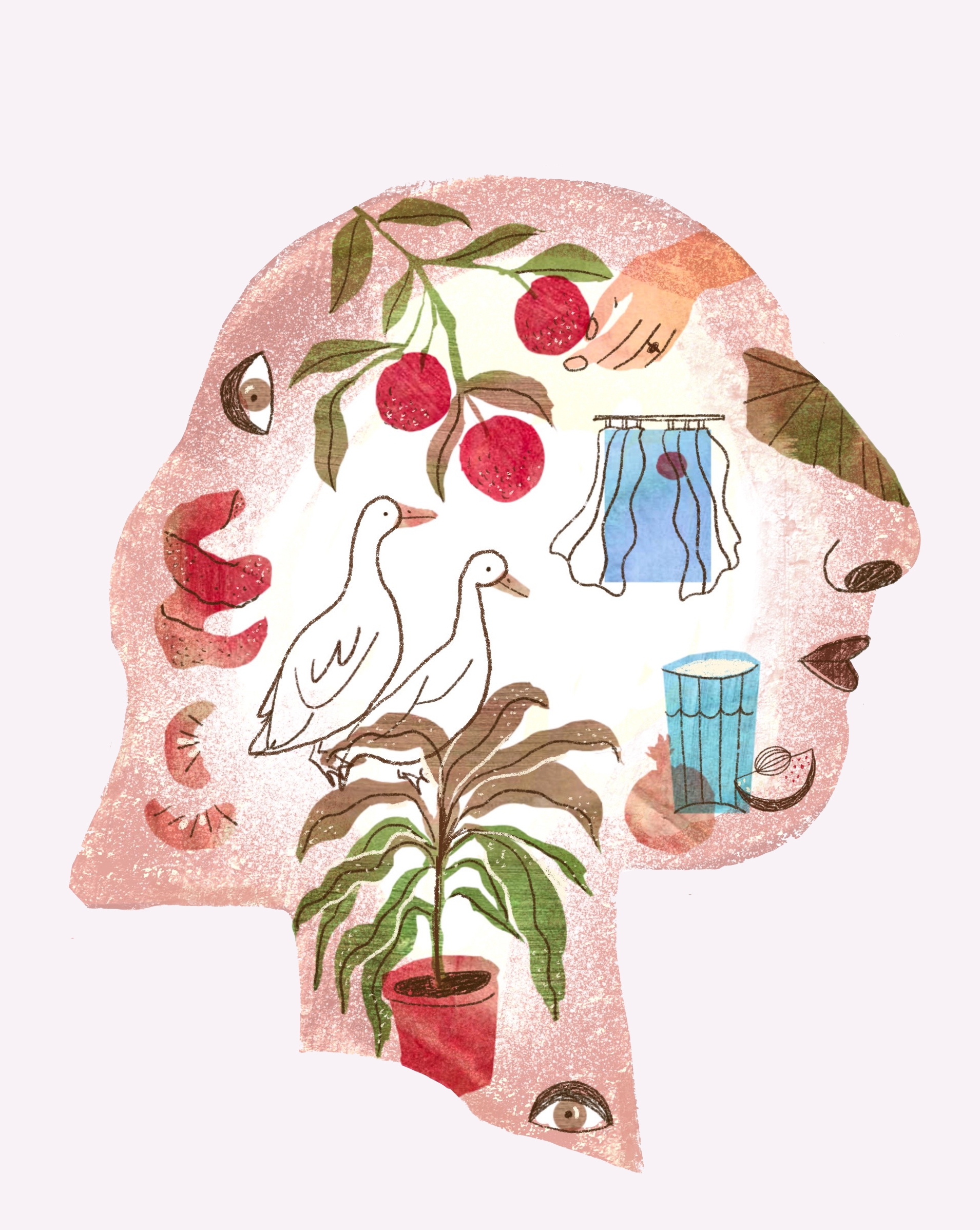
ILLUSTRATIONS BYAJ Mallari
Home—at once universal and deeply personal; a place you inhabit and a place within you; its bricks held together by mortar, its essence etched in memory. In this conversation, we explore the myths and meaning of homecoming with the lyrical poet Arundhathi Subramaniam. Arundhathi’s poems illuminate the paths of our exploration, helping us find our way back to ourselves and to each other.

Ashna Ashesh: In your poem, ‘Elegy to a Garden’, you talk about dynastic memory and the collapse of ancestral houses. What was your inherited sense of home? Was it a story of resonance, dissonance, or both?
Arundhathi Subramaniam: Both, I think. In many ways, the city that comes closest to home, for me, is Bombay/Mumbai. I was born there. It is the city in which I have grown up, studied, worked in—a city I have grown to love over the years, but to which I never quite felt I belonged.
But then I’ve never really belonged anywhere else either. I suspect most people feel that way. As a child, I believed everyone else was a round peg in a round hole, while I was a trapezium, trying desperately to fit in. As I grew older, I realized almost everyone is a closet trapezium—or has been at some point! People do a good job of concealing it, that’s all.
Mumbai's cosmopolitanism was always exciting, even if somewhat bewildering. My own cultural background wasn't monochromatic either. My father had grown up in Madras/ Chennai, and my mother in Yangon and Delhi. We had a cook from Kerala, and my elder sister and I attended a liberal downtown Parsi school in the city. So, my earliest childhood memories are of a wilderness of sounds that I later grew to recognize as English, Tamil, Hindi, Malayalam, Gujarati, and Marathi. That multicultural cauldron is something I learnt to value later. And the dynamism of the city and the Arabian Sea have never quite left me. Growing up, it seemed like one lived in a world of crazily colliding realities!
But I certainly never felt I belonged to Chennai either. For years, I associated the city largely with winter holidays in my paternal grandparents’ home. While those were enjoyable, I was always aware of being a visiting grandchild, a transit passenger, as it were.
Much was familiar about Chennai. It still is. I recognize the familiar contours of the language, the stain of sunlight on a temple courtyard, the wild surf of the Bay of Bengal, the sonorous richness of Carnatic music, the murmur of the casuarinas, the distant clang of temple bells. I can get nostalgic about it on occasion. But I have never felt like an insider.
Belonging never comes easy, does it? There is always ambivalence. Every city has its own anxieties, its own brand of parochialism, its own self-absorption. And every home has its own secrets, its own odours of unhealed ancestral traumas.
And yet, my relationship with Chennai has deepened over the years. When I sit on my balcony today, and look out at the same trees that both my grandmothers once looked at, there is gratitude. And a kind of reverence. I want those trees to thrive. I certainly want them to outlive me. At these moments, I’m almost home.
Elegy to a Garden
(Madras, November, 1995)*
Secret garden, swimming
in the amniotic light of a green afternoon,
where the trees are familiar, the pink musanda,
the thunder’s north-eastern baritone and its subtexts,
where much lies buried beneath generations of soil
and the thick sugarcane slush of rain –
in the amniotic light of a green afternoon,
where the trees are familiar, the pink musanda,
the thunder’s north-eastern baritone and its subtexts,
where much lies buried beneath generations of soil
and the thick sugarcane slush of rain –
a cosmic despair over algebra homework
rising with the aroma of turmeric and damp jasmine,
rising with the aroma of turmeric and damp jasmine,
the silent horror of my grandmother
who watched her husband drive away her cats
through the stern geometry of her kitchen window,
my fourteen-year-old indignations
near dusty bougainvillea tresses
at belonging to a tribe of burnished brahmins
that still likes to believe its skin is curdled vanilla,
and the long amorous wail
of confectioned Tamil film songs
from the transistor of a neighbour’s gardener, long dead.
who watched her husband drive away her cats
through the stern geometry of her kitchen window,
my fourteen-year-old indignations
near dusty bougainvillea tresses
at belonging to a tribe of burnished brahmins
that still likes to believe its skin is curdled vanilla,
and the long amorous wail
of confectioned Tamil film songs
from the transistor of a neighbour’s gardener, long dead.
No, I am not sentimental
about the erasure of dynastic memories,
the collapse of ancestral houses,
but it will be difficult to forget
palm leaves in the winter storm,
ribbed, fossilised,
against heaving November skies,
building up their annual heritage of anguish
before the monsoons end.
* [Where I Live: New and Selected Poems, Bloodaxe Books, UK, 2009]
about the erasure of dynastic memories,
the collapse of ancestral houses,
but it will be difficult to forget
palm leaves in the winter storm,
ribbed, fossilised,
against heaving November skies,
building up their annual heritage of anguish
before the monsoons end.
* [Where I Live: New and Selected Poems, Bloodaxe Books, UK, 2009]
Ashna: The beauty of both art and life is that this is all a flash in the pan. How has poetry helped you be at home in the impermanence of being?
Arundhathi: An interesting question.
I think this is what draws me to the lyric poem. It reminds me of that fragile tension—between earth and sky, history and eternity. It’s a truce between the rising octave of the human voice and the impenetrable silence of the universe. The lyric poem bays for the moon, snarls at time, burns for more—more life, fewer borders. That longing is a kind of madness, doomed to failure. And it is unoriginal. Still, the thirst is for real. And so, poets down the ages have continued to sing.
I think now of Blake’s line about “infinity in the palm of your hand” and “eternity in an hour.” I think of Tukaram’s line, “When he comes out of the blue, a meteorite shattering your home, be sure god is visiting you.” Think of the poems that have endured through the ages. What makes them endure, oddly, is the fact that they are about loss, longing, incompleteness. And that incompleteness can be hauntingly beautiful.
You don’t make your home in poetry if you’re looking for permanence. The architecture of poetry isn’t about brick and granite. It isn’t about termite-free wood and soundproof walls. It isn’t about living in a gated colony. Poems are meant to be porous. They’re meant to remind you that roofs will fly off and walls will crumble. And we love them because they remind us that there can sometimes be beauty in such catastrophe. When roofs fly off, there’s nothing between us and the sky. But then, as Tukaram reminds us, this might be our very first encounter with life's deepest mysteries. It might also be our very first real encounter with the moon—the obscenely shocking beauty of the moon.
Home*
Give me a home
that isn’t mine,
where I can slip in and out of rooms
without a trace,
never worrying
about the plumbing,
the colour of the curtains,
the cacophony of books by the bedside.
that isn’t mine,
where I can slip in and out of rooms
without a trace,
never worrying
about the plumbing,
the colour of the curtains,
the cacophony of books by the bedside.
A home that I can wear lightly,
where the rooms aren’t clogged
with yesterday’s conversations,
where the self doesn’t bloat
to fill in the crevices.
where the rooms aren’t clogged
with yesterday’s conversations,
where the self doesn’t bloat
to fill in the crevices.
A home, like this body,
so alien when I try to belong,
so hospitable
when I decide I’m just visiting.
* [Where I Live: New and Selected Poems, Bloodaxe Books, UK, 2009]
so alien when I try to belong,
so hospitable
when I decide I’m just visiting.
* [Where I Live: New and Selected Poems, Bloodaxe Books, UK, 2009]
Ashna: What does it mean to be at home in the world while being at home in ourselves, to be kindred co-creators of our becoming?
Arundhathi: Belonging doesn’t come easy, but that hasn’t stopped us from hungering for it.
It is easy to delude oneself into believing belonging would be easier if our lives were less complicated. What if I had continued to have lived, for instance, in my maternal grandfather’s village in a little home by the flowing Kaveri? Would life have been easier? More joyful? I don’t know. But my grandfather, by the looks of it, didn’t think so. He wanted more. Which is why he ran away from home as a young boy and built a life for himself in Myanmar!
The mind will always dream its way into a fictionalized past, a utopian future, or a mythic elsewhere. Nothing wrong with any of that. But it helps to remember that there are other ways to inhabit ourselves.
I have a poem about Muruga who returns home from his travels on his peacock. It’s called ‘When God is a Traveller’ and recalls that familiar story—of two sons choosing different ways to find the meaning of life, one remaining with his parents, and the other setting off on a journey around the world. Who is closer to home? Ganesha or Muruga? The one who opts for innocence? Or the one who opts for experience? I do see the wisdom of Ganesha’s choice, but I also feel a deep sympathy with Muruga’s more challenging life path.
And yet, once we are deeply anchored in ourselves, perhaps both choices aren’t so very different, after all? I like to believe Ganesha knows what journeys mean without ever leaving home. And I suspect Muruga will find ways to be at home even if he chooses to set out on a world sojourn all over again!

Transplant*
Show me a plant
that’s not in search
of a pot,
that’s not in search
of a pot,
that knows
whether it’s meant
for orchard,
rainforest,
or jam jar,
whether it’s meant
for orchard,
rainforest,
or jam jar,
that knows, for that matter,
if it’s a creeper,
conifer,
or just an upstart crocus
too big for its boots.
if it’s a creeper,
conifer,
or just an upstart crocus
too big for its boots.
You’d think it would get clearer with time.
It doesn’t.
It doesn’t.
And before you know it
you have yet another potted palm
with a raging heart
of Himalayan pine.
you have yet another potted palm
with a raging heart
of Himalayan pine.
Or just an old banyan
asking to be
a little less ancient,
a little less universal,
a little less absolute,
a little more bloody
bonsai.
*[When God is a Traveller, Harper Collins, India, 2014]
asking to be
a little less ancient,
a little less universal,
a little less absolute,
a little more bloody
bonsai.
*[When God is a Traveller, Harper Collins, India, 2014]
Ashna: The story of humanity has been a conversation between our migratory and homing instincts. A different narrative is unfolding now. We live in increasingly tumultuous times where migration is vilified and the ‘other’ demonized. Hate sells. Hate dictates policy and disconnects us from our shared humanity. How do we find our way back to each other in such times?
Arundhathi: I am in an airport lounge as I write this. I am surrounded by people from countries all over the world. They look different. They sound different. But many are asleep now, because of flight delays and layovers. And seeing them in unguarded states—faces relaxed, mouths open, lost to the world—is to be reminded of what it means to be human, beyond opinion, prejudice, theology, politics. Everyone here is just one more tired traveller wanting to get home.
The Bhakti poets of the Indian subcontinent have drawn me for many reasons. But here’s what inspires me the most: the intimacy of their relationship with the divine. They choose to address their gods as the ‘other’, but they refuse to subscribe to any fixed hierarchies. They don’t turn their deities into despots. They can rage and quarrel with them without hating them. They can doubt and dismiss them without ever ceasing to love them. And that’s because these poets don’t merely want to worship their gods; they want to become them. The end of their journey is about realizing—experientially—that there is no "other."
For me, this offers us a way to navigate difference. Once we start journeying into the most intimate spaces within our own hearts, and confront some of our wounds and terrors, our gaze begins to clear. Our demons and deities, we find, are our very own faces looking back at ourselves.
In a beautiful poem, the Telugu poet, Annamacharya, says of the divine, “He’s my master” and “He’s my slave.” Both can be true. Where there is intimacy, all power equations turn fluid. No single boss. No single supplicant. No single perpetrator. No single victim. There's no one to blame. All that remains is the dance of being human.
Yes, hate often seems more dominant, and policy sometimes seems to smother poetry. But those who hate others violently are often the most wounded themselves. Poems remind us of that. What can we do about this? Offer empathy and empowerment to those who need it, certainly, but also, vitally, to ourselves. It can be very challenging. But I still keep the faith that a poem’s whisper can, in the long run, go much deeper than a propagandist’s megaphone.
So, how do we find our way back to each other? By finding our way back to ourselves. A cliché, but one that we need to be reminded of many times over in a lifetime!
The Need for Nests*
This is the moment
when it returns --
when it returns --
the need to build nests,
when it isn’t enough to follow
the trails
the trails
of cranes that leap
in a silver flash of tailwind
in a silver flash of tailwind
from coastal palm trees
straight
to the moon,
straight
to the moon,
when the only thing that will settle me
is your arms, the long night
is your arms, the long night
and the friendly dialogue
of slumbering breath,
of slumbering breath,
lamplight, animality,
the cave
the cave
and the promise of laughter
in the morning.
in the morning.
Who knows, perhaps I’ll even get there,
but let it not be alone.
but let it not be alone.
Let it not be alone.
With you
the flight is pure song
and the grand tempest
of argument.
the flight is pure song
and the grand tempest
of argument.
With you
the wings of cranes
are warmed by the heat
of local fish markets.
the wings of cranes
are warmed by the heat
of local fish markets.
With you
even the moon smells
of mackerel.
even the moon smells
of mackerel.
*[Love Without a Story, Bloodaxe Books, UK, 2020]
Ashna: Your poem, "Creation Story," reads as a contemplation on the ultimate homecoming—the rewilding of self. It resonates with the words of the Jungian psychoanalyst and cantadora, Clarissa Pinkola Estés: “It is not by accident that the pristine wilderness of our planet disappears as the understanding of our own inner wild nature fades.” How might we return to the wilderness in ourselves and nurture the wilderness of this planet that is our home?
Arundhathi: In a preface to a recent book, I wrote of my own impulse to leave the big city at a certain juncture and move to an ashram in South India for a period of time. I wrote, “I don’t know if it was the call of the wild. Or the call of home. Perhaps the two are the same thing.”
What I do know is this: no one’s idea of home is an antiseptic, germ–free hospital room. It may be immaculate and safe, but we all want more than that. Home is a place of belonging and freedom. A place where we can be ourselves but also discover ourselves—less lopsidedly, less fearfully, without guilt, without the fear of judgement. That entails entering the more festering crevices of our consciousness—places where wild animals seem to lurk in the shadows, and enemies in the undergrowth. But once that journey begins, we grow into less insipid, less self-righteous, less defensive, more vital versions of ourselves. More joyous as well.
It is why Meerabai speaks of herself as “baavri.” And Manikkavachakar speaks of the “ecstasy of bewilderment.” The mystic poetry of the world is littered with breadcrumbs—clues telling us there is a way back to the blazing hearth of a truer home. It is a hearth that we once ignited, but forgot about, choosing instead to settle for a life of power cuts and stories of scarcity.
There is a contemplative way home. There is also an ecstatic way home. Clearly, our lives would be richer if we allowed ourselves to integrate the two. But we live in a world that validates the first, but is suspicious of the second. I titled my recent anthology, "Wild Women" because there are several poets who offer us a wonderfully exuberant shortcut to ourselves. They tell us we run the risk of looking crazy to others if we take this path. We could be treated to gazes of scorn and suspicion from those on more genteel journeys. But here's a simple question: who seems to be having a more exciting time?
To address the last part of your question: a gaze that refuses to divide "civilization" and "wilderness" into reductive siloes is also bound to make for a more inclusive environmental ethic. If we truly treated this planet as an extension of ourselves—as our living home, not an inanimate resource—we would obviously inhabit it very differently.
Creation Story*
Don’t be in a hurry to name
the forest
that lies between
throat
and heart,
rife with claw
and the hooded eyes
of bandits.
Prowl your way through,
howl your way through
teak forests lost
in rich shoals of cloud,
your tears incising
a river that snakes
through underbrush
and valley.
There are fearful gazes in the undergrowth.
The village elders are busy
remembering names,
the village lovers busy
dismembering them.
Disregard both.
Don’t be in a hurry
to build a highway,
to suture the past,
to smell of the future.
Allow streets, like goddesses,
to grow new limbs.
Make the detour,
breathe the estuarine air,
walk the extra mile,
so you can emerge one day,
reeking of foreign climes,
secret languages,
invisible ink,
and find the infidel
on the other side of the gates,
waiting to share lost gardens
and a wonder
as wide
as a black sherbet sky.
This is how homes are made. This is how we’re born.
This is also how we die.
the forest
that lies between
throat
and heart,
rife with claw
and the hooded eyes
of bandits.
Prowl your way through,
howl your way through
teak forests lost
in rich shoals of cloud,
your tears incising
a river that snakes
through underbrush
and valley.
There are fearful gazes in the undergrowth.
The village elders are busy
remembering names,
the village lovers busy
dismembering them.
Disregard both.
Don’t be in a hurry
to build a highway,
to suture the past,
to smell of the future.
Allow streets, like goddesses,
to grow new limbs.
Make the detour,
breathe the estuarine air,
walk the extra mile,
so you can emerge one day,
reeking of foreign climes,
secret languages,
invisible ink,
and find the infidel
on the other side of the gates,
waiting to share lost gardens
and a wonder
as wide
as a black sherbet sky.
This is how homes are made. This is how we’re born.
This is also how we die.
*[The Gallery of Upside Down Women, Penguin India, 2025]
Ashna: At this moment, what does home mean to you?
Arundhathi: Sometimes my home is the sun-soaked vegetation of the South Indian countryside. At other times, an expanse of Himalayan mountainside. Or a balcony overlooking a gasp of Arabian Sea. Or an armchair in a New York apartment looking out at a wheeling sky. When I’m in these places, of course, home is elsewhere. That's the perverseness of the human mind, of course—always looking for someplace else!
But sometimes the restlessness subsides. And then, home is less a place, more a condition. A sunlit, spacious at–homeness. There is the…freedom to play, to dream, to doodle. More breathing space inside the body. More ease inside the skin. Fewer blame games in the mind. Fewer electric fences in the heart.



You may also like
Imbibe•Issue 10
Infinite Hearth
BY Nishi Chawla

Imbibe•Issue 10
Home Beyond the Door
BY Jennifer Nandi
Imbibe•Issue 10
Of Letter Boxes, Boxes and Forest Homes
BY K Srilata
Imbibe•Issue 10
In the Shade of My Grandfather’s Tree
BY Hoihnu Hauzel

Imbibe•Issue 9
Under the Skin of Silence
BY Krittika Sharma
Imbibe•Issue 8
Co-Becoming: The Human-Dog Kinship
BY Sindhoor Pangal
Imbibe•Issue 9
How Stories Arrive: Geeta Ramanujam on Listening
BY Ramya Reddy, Rupali Goel

Imbibe•Issue 7
Roots and Resilience: A Conversation with Vanya Orr
BY Ramya Reddy